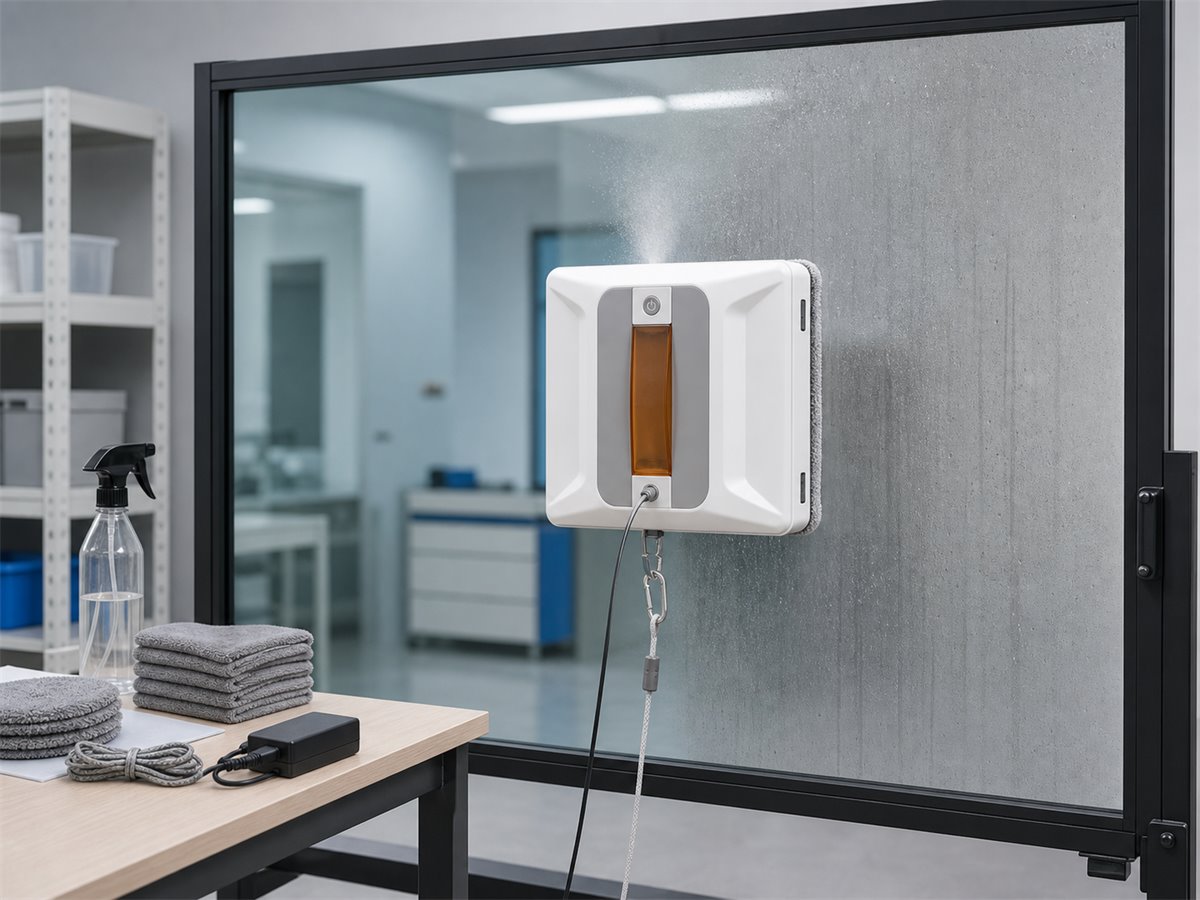
China Window Cleaning Robot Trending Worldwide Why: Global Analysis
Views: 32 Author: Site Editor Publish Time: 2026-06-27 Origin: Site
The primary factor answering the "china window cleaning robot trending worldwide why" query is the massive cost-per-clean arbitrage these devices offer over hiring professional exterior cleaning services. The right choice for global distributors depends on regional high-altitude operation safety standards and localized supply chain availability. By combining rapid OEM manufacturing with redundant fail-safes, Chinese robotics factories solved high-rise apartment maintenance permanently. A $200 initial hardware investment now directly replaces recurring $500 professional window cleaning bills.
Massive cost savings: A single unit saves up to $500 annually by eliminating professional high-rise window cleaning services.
Zero fall risk: Redundant UPS backup battery protocols keep the robot attached to the glass for 30 minutes during grid outages.
Localized supply chains: Chinese OEM manufacturing clusters reduce production iterations to 14 days utilizing in-house injection molding.
Intelligent pathing: AI path planning algorithms ensure 99% coverage of large glass facades without missing corners.
Key Pre-Purchase Considerations
Global buyers frequently ask if a Window Cleaning Robot is safe or if it will fall off the glass. A certified unit utilizes a continuous 2800Pa suction motor and physical safety tethers holding up to 150kg to guarantee zero falls.
Another concern is whether automated cleaning leaves streaks. Single-pad units often smear dirt, but the best window cleaning robot models utilize multi-nozzle atomized spray systems to dissolve grime before wiping. Finally, global distributors question the longevity of an OEM window cleaning robot from China. ISO-certified factories enforce strict quality control, operating over 130 injection machines to manage every internal component reliably.
Feature Requirement
Safety / Cleaning Benefit
Potential Drawback
Ideal Application
2800Pa Suction
Holds 1.5kg chassis in 30mph winds
65dB operating noise
High-rise exteriors
UPS Battery
Holds vacuum for 30 mins without AC
Adds 200g of weight
Unstable power grids
Atomized Spray
Dissolves dirt before the pad wipes
Requires frequent refills
Soiled outdoor glass
Edge Sensors
Reverses direction at frameless edges
Fails on extreme bevels
Frameless balconies
AI Path Planning
Cleans 2m x 2m window in 4 mins
Lacks manual spot focus
Large glass facades
Safety Tether
Withstands 150kg of drop force
Cord management required
All exterior jobs
The 4 Technological Pillars Driving Global Adoption
1. Execute AI Navigation Algorithms
Chinese window cleaning robots utilize advanced AI path planning processors to map the exact dimensions of a glass pane. The onboard gyro sensors calculate an efficient Z-shaped or N-shaped route, completing a standard 1-square-meter window in roughly 2.5 minutes.
Pro Tip: Place the robot in the bottom corner of the window to allow the AI to calibrate its X and Y axes accurately before starting.
2. Implement Redundant Fail-Safe Suction Systems
In our Lincinco R&D testing facilities, field experience consistently shows that buyers initially fear the robot falling from a 20th-story apartment. To combat this, Chinese engineers mandate a continuous 2800Pa to 3000Pa vacuum motor. If the primary cord unplugs, internal UPS backup battery protocols activate instantly, holding the unit securely to the glass for 30 minutes while sounding an alarm.
3. Deploy Multi-Nozzle Atomized Spray Mechanisms
Early generations of window cleaning robots pushed dry dust around, leaving unacceptable streaks. Today, premium units feature dual ultrasonic nozzles that atomize water into 15-micron particles. This fine mist dissolves hardened dirt exactly 5 centimeters ahead of the rotating microfiber pads, guaranteeing a streak-free finish.
4. Maximize Complete Localized Supply Chains
In practice, what our OEM partners discover after their first production run is that vertical integration drops defect rates below 0.5%. Chinese OEM robotics factories own their entire production process. By operating in-house mold design and massive injection molding arrays simultaneously, factories iterate hardware designs in 14 days rather than 6 months.
5. Calculate the Cost-Per-Clean Arbitrage
The financial logic driving this trend is undeniable. Hiring a professional high-rise window cleaning service in Europe or North America easily exceeds $300 to $500 per visit. A high-quality Chinese unit costs between $150 and $250. The machine pays for itself in less than a single afternoon of operation.
6. Integrate with Smart Home Ecosystems
Modern consumers demand interconnected appliances. Much like automated Robot Vacuum Cleaners or smart Wet Dry Vacuum Cleaners, premium window cleaners now feature smartphone application control and voice assistant integration. Users monitor real-time cleaning progress, receive notifications when the UPS battery activates, and adjust water spray volume remotely.
Common Operational Mistakes
1. Operating on Frameless Glass Without Edge Sensors
Cause: Using outdated or ultra-cheap robotic models.
Consequence: The robot loses suction when moving over the glass edge and falls.
Correction: Only purchase units explicitly advertising optocoupler edge detection sensors.
2. Ignoring the Safety Tether
Cause: The user feels confident in the primary suction motor and skips the setup.
Consequence: A grid blackout combined with a dead UPS battery results in a catastrophic drop.
Correction: Always tie the 150kg-rated safety rope to a secure indoor fixture before operating.
3. Using Excessive Cleaning Chemicals
Cause: Attempting to clean severely neglected windows rapidly.
Consequence: Microfiber pads become oversaturated, causing the driving treads to slip and stall.
Correction: Use only water or the manufacturer's specific fluid in the built-in 50ml tank.
4. Starting the Robot on a Wet Window
Cause: Attempting to clean during or immediately after a rainstorm.
Consequence: The vacuum seal fails to form on the water-slicked surface.
Correction: Only deploy the robot on completely dry days with wind speeds under 15 mph.
Troubleshooting Common Errors
Problem
Likely Cause
Solution
Slips down glass
Pads are oversaturated
Swap with dry microfiber cloths
Red light flashes
UPS battery is depleted
Charge on AC power for 2 hours
Circular streaks
Heavy, oily glass residue
Run a dry pass, then a wet pass
Stops mid-window
Snagged power cord
Provide slack in the 4m cable
Alarm sounds
Pressure dropped <2000Pa
Clean intake vent; check glass
FAQ
Why are window cleaning robots popular globally right now?
They dominate the market due to a massive cost-per-clean arbitrage. Urbanization forces millions into high-rise buildings where exterior cleaning is dangerous and costs up to $500 per visit. A Chinese window cleaning robot solves this permanently for a one-time $200 investment.
Are these robots safe to operate on exterior high-rise windows?
Yes. Premium units feature strict high-altitude operation safety standards. They utilize a 2800Pa suction motor to grip the glass, an internal UPS backup battery that holds the robot for 30 minutes during power failures, and a physical safety tether rated for 150kg.
Can they truly clean dirty exterior glass without leaving streaks?
Modern robots clean effectively by using multi-nozzle atomized spray mechanisms. Instead of pushing dry dirt around, they spray a 15-micron mist of water directly in front of the cleaning pads. This dissolves bird droppings and dust instantly, leaving a streak-free shine.
Can global buyers trust the quality control of a Chinese OEM window cleaning robot?
Absolutely. Leading Chinese robotics factories operate under rigorous ISO 9001 and BSCI certifications. By maintaining complete localized supply chains and utilizing over 130 in-house injection molding machines, these manufacturers track every component to ensure maximum longevity and sub-1% defect rates.
How long does it take an automated robot to clean a large window?
Using AI path planning algorithms, a standard robot cleans one square meter of glass in approximately 2.5 minutes. For a massive 3-meter by 3-meter balcony door, the entire automated process takes under 25 minutes with zero physical effort required from the user.
About Lincinco
When sourcing reliable hardware to capitalize on this global trend, partnering with a manufacturer that controls the entire production ecosystem ensures absolute safety and performance. Lincinco focuses on innovative R&D, rigorous quality control, and customized production to meet your market demands. Our 65-person R&D team specializes in core software algorithms, integrating smart navigation and AI recognition to give your products a competitive edge. With an annual production capacity of 4 million units and over 135 injection molding machines, Lincinco holds ISO 9001, ISO 14001, and BSCI certifications. Discover more on our About Us page.
Next Steps for Automation
The worldwide surge in window cleaning robots stems directly from rapid urbanization and the economic reality of maintaining high-rise apartments. Chinese manufacturers dominate this space by combining extreme cost-efficiency with uncompromising, redundant safety engineering. You eliminate expensive professional cleaning fees entirely while keeping your feet safely on the floor. Equip your retail inventory with these automated smart home systems to solve exterior glass maintenance permanently and capture this growing consumer demand.
A robotic pool cleaner must have strong wall-climbing ability, a firm scrubbing brush, and smart navigation that targets the waterline to effectively remove stubborn stains caused by organic residue and calcium scale. Manual scrubbing and pressure-side cleaners often fall short, so a purpose-built robotic model with dedicated waterline cleaning is the most reliable solution. Regular maintenance, proper water chemistry, and consistent cleaning schedules are also essential to prevent buildup and keep results lasting. Read More
This article explains the engineering behind robotic pool cleaners that can climb vertical walls, highlighting the use of multiple motors, advanced suction systems, and intelligent navigation to maintain adhesion and ensure thorough cleaning. It emphasizes the practical benefits of this technology, such as eliminating waterline stains and reducing manual maintenance, while also addressing the design challenges of balancing weight, power, and sensor accuracy. Read More