Views: 17 Author: Site Editor Publish Time: 2026-05-26 Origin: Site
Have you ever watched your automated cleaner seamlessly weave between dining room chairs and wondered exactly how it knows where it is going? Robot vacuums navigate by using a sophisticated combination of onboard sensors—such as LiDAR lasers, V-SLAM optical cameras, and physical bump sensors—to map their surroundings, detect obstacles, and calculate the most efficient cleaning paths in real-time. Understanding these navigation technologies is crucial for selecting the right automated floorcare solution for your home or commercial space. This article will explore how these devices avoid obstacles, explain the differences between laser and camera-based mapping, detail how basic bump-navigation works, and address how vacuums handle staircases and pitch-black rooms.
Robot vacuums navigate around obstacles by processing real-time data from an array of onboard sensors, including infrared, ultrasonic, and physical bump sensors. These sensors detect objects in the robot's immediate path, prompting the internal algorithm to instantly recalculate its route to avoid a direct collision.
Modern automated vacuums are essentially driving sensor suites. When a robot approaches a piece of furniture, infrared sensors located in its front bumper bounce light off the object to determine its proximity. If the object is too thin or transparent for infrared to detect, the physical bump sensor serves as a mechanical failsafe.
Once an obstacle is confirmed, the robot's onboard processor takes over. The navigation algorithm halts the drive wheels, calculates the exact angle required to bypass the object, and steers the chassis around the barrier while keeping its sweeping brushes as close to the edge as possible to maintain a thorough clean.
What is LiDAR navigation in robot vacuums?
LiDAR (Light Detection and Ranging) navigation uses a spinning laser turret on top of the robot vacuum to measure exact distances to walls and furniture. By calculating how long it takes for the laser to bounce back, the robot generates a precise, millimeter-level 3D map of the room.
LiDAR is widely considered the premium standard for smart home appliance navigation. You can easily identify a LiDAR-equipped model by the small, circular puck raised on top of the vacuum's chassis. Because the turret spins multiple times per second, it continuously updates the floor plan in real-time.
The advantages of LiDAR navigation are significant:
Extreme Accuracy: It creates highly precise digital boundaries and virtual "no-go" zones.
Rapid Mapping: It can scan and memorize a 2,000-square-foot floor plan in a fraction of the time it takes an optical camera.
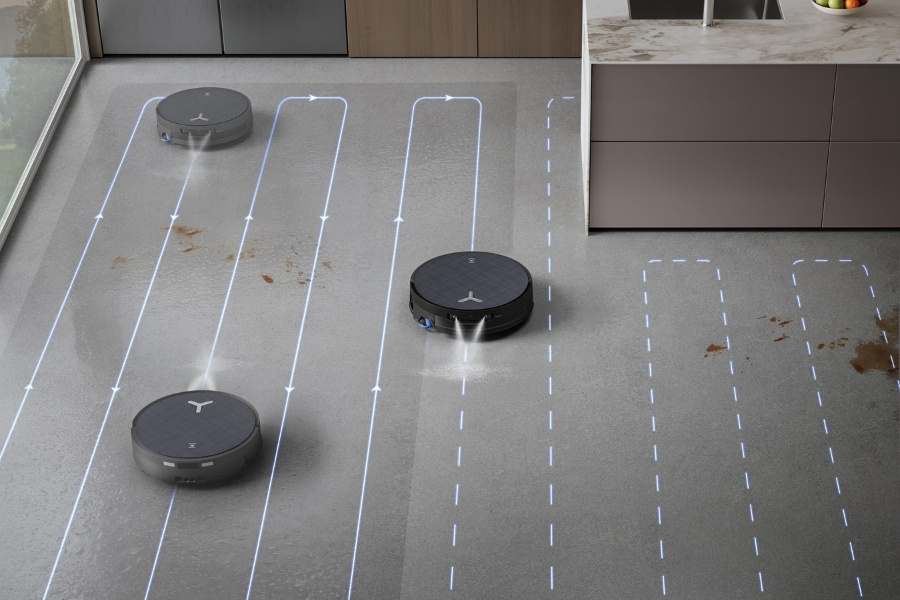
Z-Path Cleaning: It allows the robot to clean in structured, overlapping lines, guaranteeing zero missed spots.
How does camera-based (V-SLAM) navigation work?
Camera-based V-SLAM (Visual Simultaneous Localization and Mapping) navigation works by capturing thousands of upward-facing photographs of your ceiling and walls. The robot triangulates its position by tracking how distinct architectural landmarks shift frame-by-frame, allowing it to understand its location and plot a cleaning route.
Instead of shooting lasers outward, V-SLAM relies on optical pattern recognition. The top-mounted camera continuously looks for high-contrast points in your home's architecture, such as door frames, high windows, or the corners of ceilings. As the robot drives, it tracks these visual anchors to estimate its own movement.
The primary benefit of V-SLAM is its physical profile. Because these vacuums do not require a raised laser turret, the chassis can be engineered much thinner. This ultra-low profile allows V-SLAM models to easily glide under low-clearance furniture, such as modern sofas and platform beds, where taller LiDAR models might get wedged.
How do basic bump-and-navigate vacuums clean floors?
Basic bump-and-navigate vacuums clean floors using a reactive, randomized pattern rather than digital mapping. The machine drives in a straight line until its physical front bumper hits an object; it then reverses, rotates at a random angle, and continues driving until it hits the next obstacle.
These entry-level machines do not "know" your house in a digital sense and possess no internal memory of your floor plan. They rely strictly on basic physical impacts and gyroscopes to keep moving.
While these models are highly affordable, their randomized bounce pattern is highly inefficient for large homes. The robot will frequently clean the exact same patch of carpet multiple times while completely missing other sections of the room. They are best suited for small, single-room environments like studio apartments or dormitories.
Can robot vacuums navigate in the dark?
Yes, robot vacuums can navigate in the dark, but only if they are equipped with LiDAR or infrared sensors, as these technologies emit their own invisible light. Vacuums relying on optical V-SLAM cameras cannot navigate in the dark because they require ambient lighting to "see" their surroundings.
Nighttime cleaning is a major requirement for many users, particularly in commercial environments. Understanding which navigation systems rely on external light is vital for scheduling.
Navigation Technology
Primary Sensor
Performance in Total Darkness
LiDAR
Emits Infrared Lasers
Excellent (No light required)
V-SLAM
Optical Camera Lens
Fails (Cannot triangulate landmarks)
Gyroscope/Bump
Physical Tactile Switch
Good (Relies on physical impact)
How do cliff sensors prevent vacuums from falling down stairs?
Cliff sensors prevent vacuums from falling down stairs by constantly emitting infrared signals directly downward toward the floor. If the signal fails to bounce back to the receiver immediately, the robot detects a sudden drop-off and instantly reverses its drive wheels to avoid tumbling over the edge.
Located entirely on the undercarriage near the front wheels, cliff sensors act as the robot's ultimate safety mechanism. They are calibrated to recognize the specific distance between the bottom of the robot and the floor.
When the robot drives over the lip of a staircase or an interior balcony, the infrared beam shoots into the open air instead of bouncing off the flooring. The sudden lack of a return signal triggers an emergency halt in the processor. To maintain this crucial safety feature, users must wipe the optical lenses of the cliff sensors regularly to prevent dust accumulation from blinding the system.
Conclusion
The way robot vacuums navigate has evolved from simple randomized bouncing to highly complex spatial mapping. Today, these intelligent appliances rely on advanced LiDAR arrays, optical V-SLAM cameras, and safety-focused cliff sensors to autonomously maintain our living spaces. By understanding the specific strengths of these navigation technologies, consumers and facility managers can select the exact hardware that perfectly matches their architectural layout and lighting conditions. Interestingly, these advanced mapping and sensor principles are no longer limited to dry floors; similar intelligent navigation is now being engineered into modernrobotic pool cleaners and window washing units.
Partner With a Leader in Automated Manufacturing
Integrating flawless navigation technology into smart home appliances requires a manufacturing partner with deep engineering expertise. If you are a wholesale buyer or brand looking to scale your product line,Lincinco is your premier OEM and ODM intelligent manufacturing partner.
Operating a massive 50,000-square-meter facility with rigorous quality control protocols, we precision-build reliable, high-performance appliances. As one of the top robot vacuum manufacturers in the industry, we integrate aerospace-grade LiDAR mapping and advanced self-cleaning base stations directly into your private-label fleet. Contact us today to upgrade your smart appliance portfolio with automated hardware built for guaranteed supply chain excellence.
The safest way to clean cork floors is to remove loose dirt, use a cleaner compatible with the floor's finish, and limit moisture during mopping. Most finished cork floors can be maintained with regular dry cleaning and occasional damp mopping, but the correct method depends on the flooring product Read More
To clean travertine floors safely, remove loose grit, use a natural-stone-compatible cleaner, damp-mop in small sections and remove residue according to the product label. Avoid acidic cleaners that can etch the stone and abrasive tools that may scratch its finish.Travertine consists primarily of ca Read More