The Ultimate Guide to Choosing a Floor Cleaning Robot for Large Homes
For homes over 2,000 square feet, traditional cleaning methods become not just tedious but a substantial time investment that can detract from the enjoyment of the space itself. The evolution of smart home technology has brought forward a compelling solution: the autonomous floor cleaning robot. Yet, not all robots are created equal, and the features that make a model adequate for a small apartment can lead to profound frustration in a sprawling floor plan. This comprehensive guide is designed to navigate the specific, demanding requirements of large homes.
Our goal is to empower you with the knowledge to select a robotic vacuum that doesn't just clean, but systematically manages your entire home's floors, transforming maintenance from a chore into an effortless, automated process. For the large homeowner, the stakes of choosing correctly are high. An underpowered or "dumb" robot will get lost, require constant rescue, fail to complete its job, and ultimately gather dust in a closet. Conversely, the right machine becomes an indispensable member of the household, providing consistently clean floors and freeing up hours every week.
This guide moves beyond basic specifications to explore how these technologies perform in real-world, large-scale environments. We will analyze how mapping systems handle multiple rooms and floors, how battery life translates to actual coverage, and how cleaning systems adapt from hardwood to high-pile carpet. Furthermore, we will highlight how leading models, including a detailed look at the feature-rich LINCINCO M50 Pro, are engineered to meet these challenges head-on, offering a glimpse into the cutting-edge convenience available today.
Core Challenge 1: Intelligent Navigation and Mapping
The foundational capability of any robot vacuum for a large home is its ability to understand and remember its environment. Effective cleaning of a large area requires methodical, systematic coverage powered by precise mapping technology. The current industry standard for this is Light Detection and Ranging (LiDAR). A LiDAR sensor, typically housed in a rotating module on top of the robot, emits laser beams to measure distances to surrounding objects with remarkable accuracy hundreds of times per second. This allows the robot to build a detailed, real-time map of your home's layout, including walls, furniture, and other permanent fixtures.
The superiority of LiDAR becomes evident in complex environments. It functions perfectly in complete darkness, making it ideal for cleaning under beds or in closed rooms. Unlike camera-based systems that can struggle with low light or identical-looking hallways, LiDAR provides consistent, reliable data for navigation. For a multi-room home, this means the robot can efficiently travel from the living room to the kitchen to the bedrooms without confusion, plotting the most efficient path rather than wandering. Advanced robots use this map not just for cleaning, but for advanced user control.
Beyond basic mapping, obstacle avoidance is the critical second layer of intelligence. Early robots treated everything as an immovable object to be bumped into and navigated around. Modern premium robots now incorporate sophisticated sensors—often a combination of cameras, infrared sensors, and AI processors—to identify and avoid common household obstacles before making contact. This is crucial for preventing the robot from becoming a mobile nuisance that drags charging cables, scatters shoes, or pushes dog toys around.
Table: Navigation and Mapping Technologies Compared
| Technology | How It Works | Pros for Large Homes | Cons/Considerations |
| LiDAR (Laser) | Rotating laser measures distances to create a precise 2D/3D map. | Highly accurate; works in dark; fast mapping; enables room-by-room cleaning and no-go zones. | The sensor tower adds to the robot's height, potentially limiting access under very low furniture. |
| Camera-Based (VSLAM) | Uses an onboard camera to visually identify features and landmarks. | Can identify object types (e.g., shoes, cables) with AI; often allows for live-view features. | Performance can degrade in low-light or featureless environments; privacy concerns for some users. |
| Gyroscopic/Inertial | Uses wheel rotation and gyroscopes to estimate position. | Low cost; found in budget models. | Highly inaccurate for large areas; leads to missed spots and repetitive cleaning; not recommended. |
![Which floor cleaning robot is suitable for large-sized houses?]()
Core Challenge 2: Endurance and Self-Sufficiency
In a large home, a robot's cleaning session is a marathon, not a sprint. Two interrelated factors determine whether it can finish the race: battery capacity and self-maintenance capabilities. A robot with a small battery will exhaust its power before completing the job, requiring a multi-hour recharge before it can resume, dramatically extending the total cleaning time. This makes battery life one of the most critical specifications to scrutinize.
This is where the genius of automatic recharge and resume comes into play. A truly autonomous robot for a large home must have this feature. When its battery dips to a low level (typically 15-20%), it will automatically navigate back to its charging dock, recharge itself, and then return to the exact spot where it left off to complete the cleaning job. This effectively makes battery capacity a non-issue for even the largest homes, as the robot can theoretically clean indefinitely by taking recharge breaks.
However, the battery is only one part of the endurance equation. The robot's internal dustbin capacity is equally important. A small bin will fill up halfway through cleaning a 3,000 sq. ft. home, forcing the robot to stop and await manual emptying. The solution is an Auto-Empty Station. A premium robot vacuum docks into a station that uses powerful suction to empty the robot's dustbin into a much larger, sealed bag housed in the station. These bags can hold 30-60 days of debris, depending on home size and dirt levels. For a large, busy household with pets, this is a transformative feature. It means you can set a cleaning schedule for the entire week and genuinely not interact with the robot or its dust for a month or more.
For models that mop, self-sufficiency extends to water and cleaning pads. The latest generation of robotic mops addresses the hassle of manual maintenance with Auto-Washing and Drying Stations. After mopping, the robot returns to its station, where the mop pads are automatically scrubbed clean with fresh water, sometimes with added cleaning solution. The pads are then dried using warm air to prevent mildew and odors—a feature particularly valued in humid climates. The most advanced systems even feature auto-refill and auto-drain for the clean and dirty water tanks, connecting directly to your home's plumbing for true weeks-long, hands-free mopping autonomy.
Core Challenge 3: Adaptive Cleaning Performance
A large home invariably features a variety of floor types—hardwood in living areas, tile in kitchens and bathrooms, and various carpets and rugs. A capable cleaning robot must not only navigate these different surfaces but also adapt its cleaning method to each one for optimal results. This adaptation hinges on three key systems: suction power, brush design, and carpet detection.
Suction power, measured in Pascals (Pa), is the engine of the vacuum. While marketing materials often tout extremely high numbers, the practical need for suction in a large home is about having adequate reserve power for carpets. For deep cleaning embedded dirt in medium- to high-pile carpets, strong suction is essential. However, extreme suction (e.g., 20,000 Pa and above) is often overkill for daily hard floor maintenance and can rapidly deplete the battery.
The smarter solution is a robot with auto-boost suction triggered by carpet detection. This technology uses sensors (often ultrasonic) to identify when the robot transitions from a hard floor to a carpet. Upon detection, it automatically increases suction power, sometimes by 50% or more, to provide a deeper clean. Simultaneously, if the robot is a hybrid model with a mopping function, it should automatically retract or lift its mopping pad to prevent wetting the carpet.
Brush roll design is paramount for preventing maintenance headaches, especially in homes with pets or long-haired residents. The traditional bristle brush is effective at agitating carpets but is notoriously prone to tangling with hair, requiring frequent, tedious manual cutting to remove wraps. The modern solution is the rubber or silicone brush roll. These brushless designs use flexible fins to channel debris into the vacuum intake while actively preventing hair from wrapping. Some high-end models now feature dual brush rolls—a combination of rubber and bristle—designed to offer the deep-cleaning agitation of bristles with the anti-tangle properties of rubber. For pet owners, this is a critical feature that dramatically reduces daily maintenance.
Finally, the mopping system itself has evolved. Basic models drag a damp cloth behind them, which offers minimal scrubbing action. Advanced models feature oscillating or rotating mopping pads that vibrate or spin at high speeds to scrub the floor, mimicking a hand-cleaning motion. This is far more effective at removing dried-on spots and ground-in dirt. The LINCINCO M50 Pro, for example, incorporates a pressurised mopping system that ensures consistent contact with the floor for superior stain removal. When considering a mopping robot for a large area of hard floor, ensure it has a large, electronically controlled water tank that can distribute moisture evenly across the entire job without needing a refill.
The High-Performance Contender: LINCINCO M50 Pro
Having established the rigorous demands of a large home, let's examine how a robot like the LINCINCO M50 Pro is engineered to meet them. This model exemplifies the integration of the core technologies necessary for large-space autonomy and performance.
At the heart of the M50 Pro's intelligence is a precision LiDAR navigation system. This allows it to map your home with millimeter-level accuracy, creating a reliable blueprint for efficient, methodical cleaning. The generated map is not static; the robot's AI learns and optimizes cleaning paths over time, ensuring the most logical and thorough coverage room by room. In practice, this means no missed corners in a spacious great room and efficient transit through doorways and hallways. The accompanying app provides full control, allowing you to set virtual boundaries (no-go zones to protect areas like pet feeding bowls or fragile furniture), schedule cleanings for specific rooms at specific times, and monitor cleaning history.
For endurance, the M50 Pro is built for the long haul. It is equipped with a high-capacity lithium-ion battery designed to deliver extended cleaning sessions. More importantly, it fully supports the essential Auto-Recharge & Resume function. You can confidently start a whole-home cleaning cycle knowing that if the battery runs low, the robot will seamlessly dock, recharge, and pick up exactly where it left off, guaranteeing complete coverage regardless of your home's square footage.
Its cleaning performance is both powerful and adaptable. The M50 Pro features strong, adjustable suction capable of pulling dirt from both hard floors and carpet fibers. It pairs this with an anti-tangle main brush specifically designed to minimize hair wraps, a blessing for households with shedding pets. As a hybrid vacuum-and-mop model, it tackles hard floor cleaning with its precision mopping system, which applies even pressure and controlled water flow to lift dirt without leaving streaks. While it benefits from pairing with LINCINCO's optional Auto-Empty Dock and Mop Washing Dock for ultimate hands-free convenience, its core design focuses on delivering reliable.
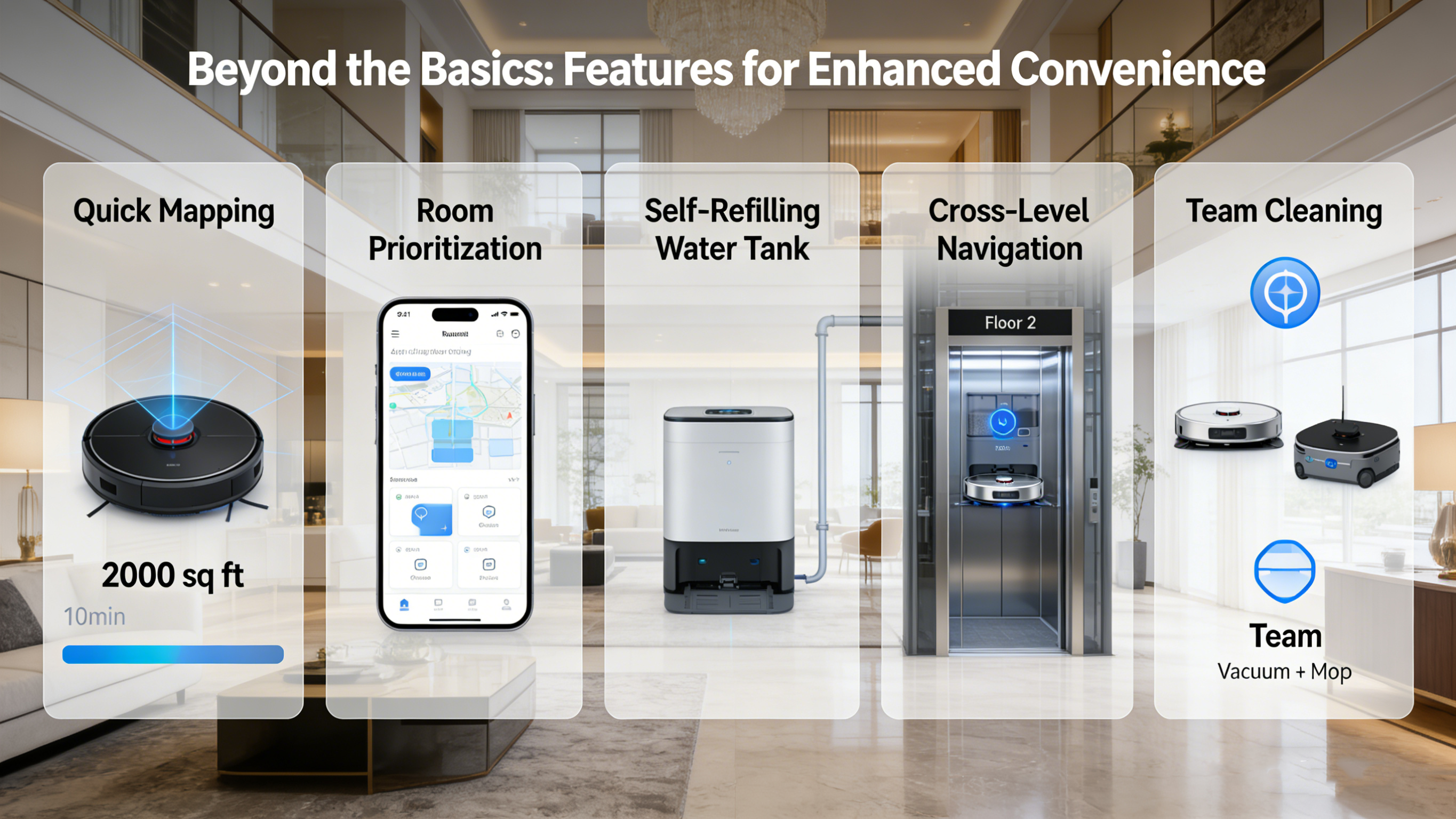
Beyond the Basics: Features for Enhanced Convenience
For the discerning owner of a large home, several additional features can elevate the robot vacuum from a useful tool to an indispensable part of home management.
Multi-floor mapping is essential for homes with more than one level. Advanced robots can store and recognize multiple unique maps—one for each floor of your home. When you physically carry the robot to a different floor and start a cleaning cycle, it will recognize its location from the existing map or quickly create a new one if it's the first time. This allows you to maintain separate cleaning schedules and no-go zones for your main floor, upstairs bedrooms, and basement.
Cleaning History and Reports within the app offer transparency and insight. You can see exactly which rooms were cleaned, how long it took, and the total area covered. This is not just about satisfaction; it helps you understand cleaning patterns and confirm that your entire space is being serviced.
Finally, for the ultimate in futuristic home management, some premium models now include a Livestream Camera and Two-Way Audio. This transforms the robot into a mobile home monitoring platform. You can remotely drive it around the house to check on pets, look for misplaced items, or even communicate with family members through the built-in speaker. While not a core cleaning feature, it represents the exciting convergence of home robotics, security, and convenience.
![Beyond the Basics: Features for Enhanced Convenience]()
Making the Final Decision: A Checklist for Large Homes
Armed with this knowledge, your selection process should be guided by a checklist tailored to the scale of your home:
Navigation & Mapping: Does it use LiDAR for precise, room-by-room mapping and scheduling?
Battery & Autonomy: Does it have long runtime (180min+) and the essential Auto-Recharge & Resume feature?
Self-Emptying: Can it be paired with an Auto-Empty Station to manage dust for weeks at a time?
Surface Adaptation: Does it have auto-boost suction on carpets and auto-lift mop pads to protect rugs?
Brush Design: Does it feature an anti-tangle brush roll to minimize maintenance from hair and pet fur?
Mopping (If Desired): Does it have an oscillating/rotating mop and a large water tank for effective large-area cleaning?
App Control: Does the app allow for multi-floor mapping, no-go zones, and room-specific cleaning?
Home Integration: Does it support voice control with your preferred smart home system?
The robot vacuum market is a flagship example of global innovation, with cutting-edge products frequently emerging from leaders in the field. For a large home, investing in a model that checks these boxes—such as the LINCINCO M50 Pro or other high-end counterparts—is an investment in time and comfort. It represents a decision to offload a recurring, time-consuming task to a diligent, intelligent system.
By prioritizing intelligent navigation, true endurance, and adaptive cleaning power, you can select a robotic partner that doesn't merely function in your large home but thrives in it. The result is a consistently clean living environment and the precious gift of time—to enjoy the spacious home you've worked so hard to create.