Introduction: The Sound of Floor Cleaning Robot
The floor cleaning robot represents one of the most successful adoptions of home automation, offering the undeniable benefit of clean floors with minimal daily effort. However, this convenience comes with an unavoidable sensory companion: sound. As these devices hum, whir, and navigate through our living spaces, a common and valid concern arises: Will the noise from the floor cleaning robot be very loud? For many potential buyers, the fear of introducing a disruptive, grating appliance into their home environment is a significant barrier to purchase.
The perception of noise is highly subjective. What is a background murmur to one person can be a distracting annoyance to another. Factors such as the layout of your home, the time of day you prefer to clean, your household's activities (working from home, napping children, sensitive pets), and individual hearing sensitivity all play a crucial role in determining what is "too loud." This guide will move beyond subjective impressions to provide objective, actionable information. We will explain how robotic vacuum noise is measured, what typical decibel ranges you can expect from different models and modes, and how this sound compares to common household appliances. More importantly, we will delve into the engineering trade-offs that create noise—primarily the relationship between suction power, brush speed, and sound output—and highlight the technologies and design choices manufacturers use to achieve quieter operation.
Part 1: Measuring Sound - The Decibel Scale Explained
To objectively discuss robotic vacuum noise, we must first understand the unit of measurement: the decibel (dB). The decibel scale is logarithmic, not linear. This means an increase of 10 dB represents a sound that is perceived as approximately twice as loud to the human ear. For example, a 60 dB sound is not just "a little" louder than a 50 dB sound; it is subjectively about twice as loud.
Common Points of Reference on the dB Scale:
30 dB: A quiet whisper or a library.
40-50 dB: A quiet conversation at home or moderate rainfall.
60 dB: Typical conversational speech or an office environment.
70 dB: A washing machine, dishwasher, or the interior of a moving car.
80 dB: A garbage disposal, blender, or noisy city street.
90 dB+: Prolonged exposure can risk hearing damage.
When manufacturers list a noise level for a robotic vacuum, such as "operates at 58 dB," this is typically a measurement taken under specific test conditions, often at a distance of one meter on a standard hard floor in its quietest mode. It is crucial to note that in-room perception will differ. Sound levels can be higher or lower depending on room acoustics, flooring (carpets absorb sound), and your distance from the robot.
Part 2: Typical Noise Levels of Robotic Vacuums
Robotic vacuums are not monolithic in their sound output. Their acoustic profile varies dramatically based on their cleaning mode and fundamental design.
Quiet/Eco Mode: This is the setting designed for minimal disruption. In this mode, the suction fan motor runs at a reduced speed, and the main brushroll may rotate more slowly. Noise levels in this mode typically range from 55 dB to 65 dB. At the lower end of this range (55-58 dB), the sound is comparable to a subdued conversation or background office chatter. It is noticeable but often manageable for activities like watching TV or having a phone call in an adjacent room.
Standard/Auto Mode: This is the default cleaning mode for most robots during a scheduled clean. It balances suction power and noise, usually operating between 65 dB and 70 dB. This is similar to the sound of a window air conditioning unit or a dishwasher. It is a clearly audible, steady hum that would make conversation in the same room somewhat difficult but is often fine for other areas of an open-plan home.
Max/Boost/Turbo Mode: When the robot detects a carpet or is manually set to its highest power setting, it unleashes its full suction. This significantly increases noise, with levels commonly reaching 70 dB to 78 dB or higher. At this level, the sound is comparable to a traditional upright vacuum cleaner (which often operates at 75-85 dB) or a hair dryer. It is loud, focused, and disruptive to most other activities in the immediate vicinity.
Important Note on "dB(A)": You will often see noise measured as dB(A). The "(A)" denotes that the measurement is A-weighted, meaning the scale is adjusted to reflect the sensitivity of the human ear, which hears mid-frequency sounds more prominently than very low or very high ones. This provides a more accurate representation of perceived loudness.
Table: Robotic Vacuum Noise Levels in Context
| Operating Mode | Typical Decibel Range (dB(A)) | Common Sound Equivalent | Suitability for Activities |
| Quiet / Eco Mode | 55 - 65 dB | Moderate rainfall, background office chatter. | Good: Working in another room, light sleepers nearby. Poor: Demanding concentration in the same room. |
| Standard / Auto Mode | 65 - 70 dB | Dishwasher, window AC unit, washing machine. | Fair: General household activity in other areas. Poor: Conversation or media in the same room. |
| Max / Boost / Turbo Mode | 70 - 78+ dB | Upright vacuum, hair dryer, food blender. | Poor: Disruptive to all but the noisiest environments. Best used when home is empty. |
| Traditional Upright Vacuum | 75 - 85 dB | Upright vacuum (reference point). | Manually operated, high-impact, short-duration noise. |
![Will the noise from the floor cleaning robot be very loud?]()
Part 3: The Sources of Noise - More Than Just a Motor
The sound you hear from a robotic vacuum is a symphony (or cacophony) produced by several components working in tandem. Understanding these sources helps explain why noise varies and how it can be managed.
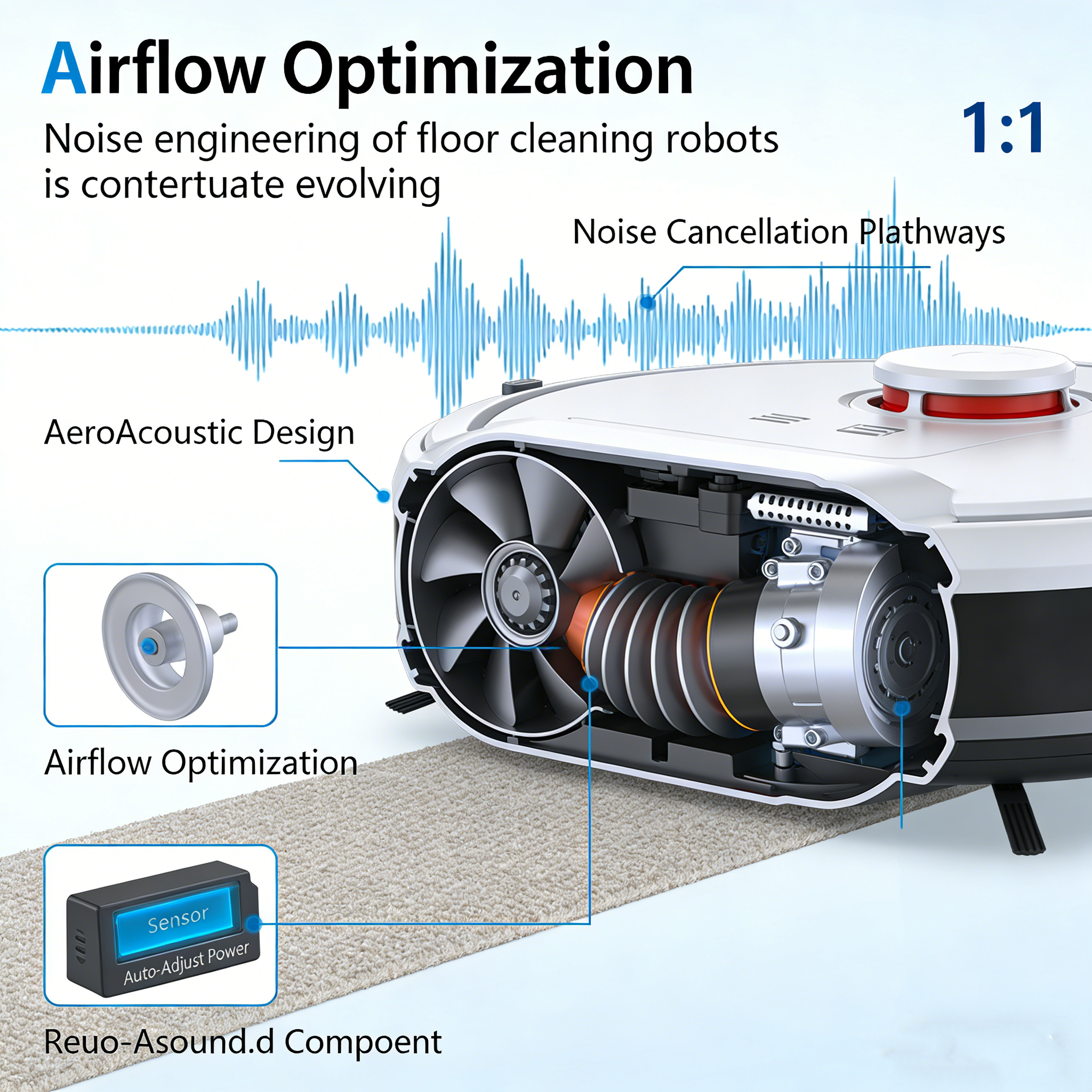
1. The Suction Motor and Fan: This is the primary source of the characteristic vacuum "hum" or "whine." The speed (RPM) of the motor and the design of the fan blades that move air create a dominant mid-to-high-frequency tone. Higher suction power demands higher motor speed, which directly increases pitch and volume.
2. The Brushroll System: The rotating main brush, especially on hard floors, creates a distinctive swirling or brushing sound. Debris like cereal or cat litter hitting the plastic brush housing creates intermittent "ticks" and "clacks." On carpets, this sound is more muffled, but the motor strain to turn the brush is higher.
3. The Drive System: The motors that propel the robot's wheels create a lower-pitched whirring or grinding sound, particularly noticeable when the robot is turning, climbing onto a rug, or trying to free itself from an obstacle.
4. Airflow and Vibration: As air rushes through the internal passages (the "air path"), it can create whistling or whooshing sounds, especially if the path has sharp bends or constrictions.
Furthermore, if components are not perfectly dampened, the motor's vibration can be transmitted to the robot's plastic shell, causing it to act as a sounding board and amplifying the noise.
Part 4: Strategies for a Quieter Experience - Before and After Purchase
You have significant control over the acoustic impact of a robotic vacuum through informed selection and smart usage.
Choosing a Quieter Model:
Look for Specific Quiet Mode dB Ratings: Prioritize models that publish a low dB number for their quiet mode (aim for low 60s dB or below). The Lincinco H90 floor cleaning robot adopts an integrated design, effectively reducing the noise level. The sound it emits does not cause any pollution to the ears, and it can be safely used in the home.
Consider Brushless Motors: Some high-end models use digitally controlled brushless motors, which can be more efficient and sometimes quieter than traditional brushed motors.
Read Reviews for "Real-World" Sound Impressions: Professional and user reviews often describe the sound character (e.g., "high-pitched whine" vs. "low rumble") better than a spec sheet can.
Evaluate Navigation Intelligence: A robot with precise LiDAR navigation cleans methodically and gets stuck less often, reducing the noisy struggle and backtracking that bump-and-go robots exhibit.
Optimizing Usage in Your Home:
Leverage Scheduling: This is the most powerful tool. Program the robot to run during natural breaks in your household's day—when you are at work, running errands, or out for an evening. Modern apps make this easy.
Use Zone Cleaning: If you only need the kitchen cleaned after dinner, use the app to send the robot just to that zone instead of running a whole-house noisy cycle.
Maintain Your Robot: A clean robot is often a quieter robot. Regularly remove hair and debris wrapped around the brushroll and empty the dustbin. A clogged filter forces the motor to work harder and louder.
![noise engineering of floor cleaning robots is constantly evolving.]()
Part 5: Special Considerations for Noise-Sensitive Households
For some, managing noise is not a preference but a necessity.
Households with Babies and Young Children: Naptime is sacred. A robot with a reliable, truly quiet sub-60 dB mode can be a game-changer for maintaining cleanliness during the day without risking a wake-up. Precise scheduling is also essential.
Pet Owners: Many dogs and cats are sensitive to sudden, consistent noises. The initial introduction of a robot should be gradual, using the quietest mode. Observe your pet's reaction. Some pets habituate quickly; others may remain stressed, necessitating running the robot only when they are in another part of the house or outdoors.
Home Offices and Concentrated Work: For those who work from home, a loud robot in the background can disrupt video calls and concentration. A model with a quiet mode and the ability to clean a specific zone (like the kitchen during a coffee break) is ideal. Noise-cancelling headphones can also bridge the gap.
Open-Plan Living Spaces: In homes where the kitchen, dining, and living areas are one continuous space, the sound of a robot cleaning the kitchen will permeate the entire area. In these layouts, strategic scheduling for times when the space is unoccupied is often the only viable solution for using higher-power modes.
Conclusion: Finding Your Acoustic Balance
The noise from a floor cleaning robot does not have to be "very loud." Through advancements in acoustic engineering and smart features, today's market offers a spectrum of choices. By understanding decibel levels and their real-world equivalents, you can demystify the specifications. By acknowledging the sources of noise, you can appreciate the trade-off between powerful cleaning and quiet operation. Most importantly, by strategically using scheduling, zoning, and home layout to your advantage, you can integrate this automated helper into your life on your terms.
The goal is not necessarily to find a silent robot—that technology does not yet exist for effective cleaning—but to find one whose sound profile and operational intelligence align with your household's rhythm and sensitivity. A well-chosen robot will clean your floors not as a noisy intruder, but as a discreet, predictable background service, delivering its invaluable convenience without compromising your home's peace.