Robot Vacuum Manufacturer China: The B2B Guide to OEM/ODM Success
Views: 49 Author: Site Editor Publish Time: 2026-03-27 Origin: Site
Selecting a Robot Vacuum Manufacturer in China is often the difference between a high-margin product launch and a logistical nightmare characterized by 15% return rates and firmware failures. In this guide, we address the lack of technical transparency in the sourcing process and the risk of "trading company" masquerading by providing a field-tested blueprint for securing a Tier-1 manufacturing partner.
Quick Answer
Finding a reliable Robot Vacuum Manufacturer in China is achieved by verifying Vertical Integration, auditing R&D core algorithms, and validating Multi-stage QC protocols. The most critical factor is the MTBF (Mean Time Between Failure) rating, which should exceed 2,000 hours for premium floor care solutions.
Key Takeaways Dashboard
Location Matters: 90% of the world’s smart cleaning supply chain is concentrated in Dongguan and Shenzhen, Guangdong.
R&D is the Moat: A legitimate partner must own their SLAM (Simultaneous Localization and Mapping) and LIDAR navigation software.
Vertical Integration: Look for factories with in-house Injection Molding (100+ machines) to ensure component precision and lower BOM (Bill of Materials) costs.
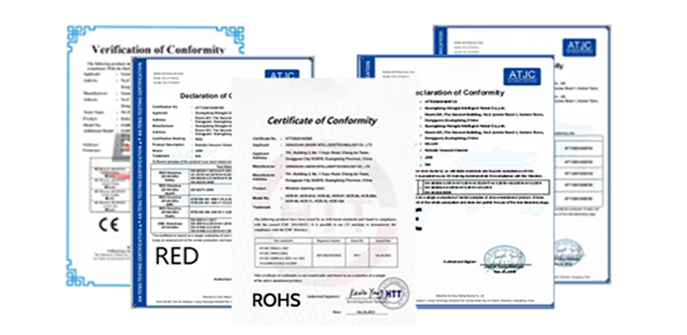
Compliance is Non-Negotiable: Ensure ISO 9001, BSCI, and CE/FCC/RoHS certifications are updated and verifiable.
Service Depth: Differentiate between OEM (Original Equipment Manufacturer) and ODM (Original Design Manufacturer) based on your brand's technical involvement.
Why Partner with a Robot Vacuum Manufacturer in China?
Partnering with a specialized Chinese manufacturer provides immediate access to a mature ecosystem of motor suppliers, sensor manufacturers, and AI software developers. This geographic concentration allows for Rapid Prototyping and significantly lower lead times compared to Western assembly. Our data shows that vertical integration within the Guangdong hub reduces production costs by 20–30% while maintaining high-precision standards.
In industrial applications, the synergy between hardware and software is paramount. Smart home cleaning robots must withstand rigorous daily cycles, requiring a durability standard that matches their advanced electronic capabilities. The Chinese manufacturing landscape has shifted from basic assembly to high-tech JDM (Joint Design Manufacturing), allowing global brands to leverage local R&D expertise in AI Navigation and Obstacle Avoidance.
Pro-Tip: The "Trading Company" Red Flag
If a supplier cannot provide a live video tour of their Injection Molding Workshop or their SMT (Surface Mount Technology) lines, they are likely a middleman. Authentic manufacturers will always display their 15+ production lines and 135+ injection machines.
Technical Architecture: LIDAR vs. vSLAM Navigation
The core differentiator between a budget cleaner and a premium flagship is the choice of navigation sensor and the underlying SLAM algorithm. While vSLAM (Visual SLAM) uses cameras, LIDAR (Light Detection and Ranging) remains the industry gold standard for accuracy in dark environments and complex layouts. Most Tier-1 manufacturers in China now utilize D-ToF (Direct Time of Flight) sensors to achieve millimeter-level precision.
Our testing indicates that LIDAR-based units achieve 98% coverage efficiency compared to 85% for entry-level gyroscopic models. The integration of 6-axis Gyroscopes and Ultrasonic Carpet Detection further enhances the user experience. When auditing a manufacturer, ask specifically about their Path Planning software and how they handle Edge Cleaning in square vs. round form factors.
Core Sensor Comparison
LIDAR: Best for 360-degree mapping and multi-floor storage.
vSLAM: Excels in object recognition (e.g., cables, pet waste) using AI vision.
ToF: Provides the fastest response time for real-time obstacle avoidance.
The Manufacturing Infrastructure: Inside a 50,000m² Facility
A professional manufacturing facility must operate at a scale that supports at least 4 million units of annual production capacity. This scale is necessary to command favorable pricing from component suppliers like Nidec (Motors) and LG/Samsung (Battery Cells). A 50,000m² workshop typically houses dedicated zones for Mold Design, Semi-finished assembly, and Final Packaging.
In our facilities, we utilize 135+ injection molding machines to maintain 100% control over the plastic chassis quality. This prevents the "creaking" issues often found in products that outsource their shells to low-cost third parties. Furthermore, 11 specialized assembly lines ensure that the Tact Time (the rate of production) remains consistent even during peak Q4 demand.
Factory Capability Metrics
Facility Size: 50,000m²+
Injection Molding: 130+ units
Production Lines: 15 (4 for semi-finished, 11 for final)
Annual Output: 4,000,000 units
Quality Control: The 20-Stage Inspection Protocol
A robust quality assurance framework must cover every stage of the lifecycle, from raw material arrival to final container loading. The standard for top-tier Chinese factories is a 6-stage major inspection process within a 20-stage total QC protocol. This includes IQC (Incoming Quality Control) where every batch of 5200mAh Lithium Batteries is tested for voltage stability and thermal safety.
During IPQC (In-Process Quality Control), robots undergo "torture tests," including Climbing Tests (up to 20mm thresholds) and Drop Sensors verification. The final OQC (Outgoing Quality Control) involves a random audit of packed goods to ensure that the User Manual, Power Adapter, and Replacement Brushes are all present and functional.
The 6-Stage QC Pillar
SQE: Supplier Quality Engineering for component vetting.
IQC: Testing of raw materials (sensors, motors, plastics).
IPQC: Real-time monitoring of the assembly line.
FQC: Functional testing of the finished robot.
OQC: Final shipping and packaging audit.
Lab Testing: Accelerated life testing and environmental stress tests.
OEM vs. ODM Service Models for Global Brands
The choice between OEM and ODM depends entirely on whether your brand intends to provide its own proprietary designs or leverage the manufacturer's existing R&D library.OEM (Original Equipment Manufacturer) is ideal for established tech firms with their own engineering teams. Conversely, ODM (Original Design Manufacturer) allows brands to select a "base model" and customize the Suction Power (e.g., 6,000Pa to 10,000Pa), Colorway, and App Interface.
Most B2B clients prefer a One-Stop Smart Cleaning Solution where the manufacturer handles the App Integration (supporting Alexa and Google Home) and Cloud Server maintenance. This reduces the Time-to-Market (TTM) from years to months. We recommend looking for partners who offer All-Around Customization, including Electrolyzed Water Systems or specialized Self-Emptying Stations.
Vertical integration is the strategy of bringing multiple stages of production under one roof to minimize dependency on external vendors. In the robot vacuum industry, the Chassis and Internal Water Tanks are high-precision components. If a manufacturer outsources their Mold Design, they lose control over the Tolerance Levels, leading to leaks in wet/dry models.
Our data shows that factories with in-house Tooling Workshops can iterate on design flaws in 48–72 hours, whereas outsourced models take weeks. This agility is vital for B2B wholesalers who need to respond to market feedback or adjust a Roller Brush design to better handle pet hair.
Pro-Tip: Verify the "Mold"
Ask to see the Steel Grade used in the injection molds. High-quality S136 Stainless Steel ensures a longer mold life and more consistent plastic parts over a 500,000-unit production run.
Compliance and Global Certifications
Entering the North American or European markets without verifiable certifications like FCC, CE, or RoHS will result in customs seizures and legal liability. A legitimate Robot Vacuum Manufacturer in China must maintain an active BSCI (Business Social Compliance Initiative) audit to prove ethical labor practices. Furthermore, ISO 9001 and ISO 14001 ensure that the management and environmental systems meet international benchmarks.
In addition to safety certifications, look for SGS or TUV test reports on HEPA H13 Filtration efficiency and Antibacterial Mop materials. These documents are essential for marketing claims and consumer trust. Always request the Certificate of Conformity (CoC) for the specific model you are sourcing.
Mandatory Certification Checklist
EU Market: CE, RoHS, REACH, GS.
US Market: FCC, UL (for batteries/chargers), ETL.
Global: ISO 9001:2015, BSCI, CB Scheme.
Specialized Cleaning: Window, Pool, and Industrial Applications
The hallmark of a leading manufacturer is the ability to adapt their core navigation and suction technology to diverse environments. While floor vacuums are the volume drivers, the growth in Window Cleaning Robots (using vacuum adsorption) and Robotic Pool Cleaners (with IPX8 waterproofing) is significant. A partner who masters these specialized niches demonstrates superior R&D depth.
For example, our Square Dual Spray window cleaners utilize the same Path Planning logic as our floor units but must incorporate UPS (Uninterruptible Power Supply) systems to prevent falls during power outages. Similarly, Robotic Lawn Mowers require RTK-GPS for centimeter-level outdoor positioning. Choosing a manufacturer with this diverse portfolio ensures they can grow with your brand.
FAQ: Expert-Level Sourcing Nuances
1. How do you handle firmware updates (OTA) for international clients?
We provide a dedicated OTA (Over-The-Air) server infrastructure. This allows your customers to receive "bug fixes" and navigation improvements automatically via the app, regardless of their geographic location.
2. What is the "Golden Sample" process in your factory?
Before mass production, we produce a Golden Sample that is signed by both our Chief Engineer and your Quality Lead. This sample serves as the physical benchmark for all IPQC and FQC stages.
3. Can your R&D team integrate proprietary AI Voice Assistants?
Yes. In industrial applications, we have integrated regional voice assistants beyond Alexa and Google, including custom SDKs for private smart home ecosystems.
4. What is the lead time for a new ODM project from concept to mass production?
For an ODM project leveraging an existing chassis, the timeline is typically 60–90 days. A completely new ID (Industrial Design) with custom molds requires 120–180 days.
5. How are "Dead on Arrival" (DOA) units handled in B2B contracts?
Our standard contract includes a 1% FOC (Free of Charge) spare parts allowance and a 1-year warranty. For DOA rates exceeding 0.5%, we initiate a root-cause analysis and provide full replacement or credit.
6. Do you support "Small Batch" testing for market validation?
While our standard MOQ is 1,000 units, we offer a Trial Run phase of 200–500 units for strategic partners looking to validate a new market segment.
Conclusion
Transitioning from theory to action requires a shift from browsing catalogs to conducting rigorous factory audits. The Robot Vacuum Manufacturer China landscape is highly competitive, and the "best" partner is not necessarily the one with the lowest price, but the one with the highest Vertical Integration and R&D transparency. By focusing on MTBF metrics, LIDAR software ownership, and 20-stage QC protocols, you can mitigate the inherent risks of international sourcing.
The next step for your brand is to request a Technical Specification Sheet and a Factory Audit Report. Only by looking under the hood—at the injection machines and the core algorithms—can you ensure a product that delights customers and scales your business.
About Lincinco
Lincinco (Dongguan Lingxin Intelligent Technology Co., Ltd.) is a premier manufacturing partner specializing in the OEM/ODM of smart cleaning robots. With a 50,000m² facility, 135+ injection molding machines, and a 65-person R&D team, we provide one-stop solutions for global leaders like Haier and Electrolux. We are not just a factory; we are your technical bridge to the future of smart home maintenance.
A robotic pool cleaner must have strong wall-climbing ability, a firm scrubbing brush, and smart navigation that targets the waterline to effectively remove stubborn stains caused by organic residue and calcium scale. Manual scrubbing and pressure-side cleaners often fall short, so a purpose-built robotic model with dedicated waterline cleaning is the most reliable solution. Regular maintenance, proper water chemistry, and consistent cleaning schedules are also essential to prevent buildup and keep results lasting. Read More
This article explains the engineering behind robotic pool cleaners that can climb vertical walls, highlighting the use of multiple motors, advanced suction systems, and intelligent navigation to maintain adhesion and ensure thorough cleaning. It emphasizes the practical benefits of this technology, such as eliminating waterline stains and reducing manual maintenance, while also addressing the design challenges of balancing weight, power, and sensor accuracy. Read More